
Securing a Shared Driveway: Practical Steps for Fair Access and Security
A barrier can make a shared driveway harder to use if access hasn’t been agreed first. Securing a shared driveway means balancing protection with fair, convenient access for everyone who has a right to use it. Who can approve a change, and how can you avoid disrupting neighbours, visitors or deliveries?
Settle those questions before choosing a gate, bollard or other physical measure. The right option depends on the security concern, the driveway’s layout and the access arrangements in the property documents.
This guide explains how to agree practical access rules, assess risks and compare security measures for a shared driveway. It also covers permissions, vehicle movements and the space a barrier needs to operate without obstructing access. A clear plan helps improve security without treating a shared entrance as if it belongs to just one household.
Table of Contents
Securing a shared driveway starts with agreeing how it is used
A barrier may deter unwanted vehicle access, but it can disrupt daily routines if it blocks a neighbour, visitor or delivery driver. First, work out who relies on the driveway and what needs to remain accessible. One entrance might serve several homes, provide access for tradespeople and deliveries, and include parking or turning space shared by more than one household.
Be precise about the concern. Unauthorised parking, vehicles entering the property and exposure around an open boundary are different issues, and may call for different responses. A physical barrier should support agreed access arrangements, not determine them. If residents have different rights or responsibilities, property documents may refer to an easement. The overview of Easement (property law) explains the general concept, but the relevant property documents matter for a particular driveway.
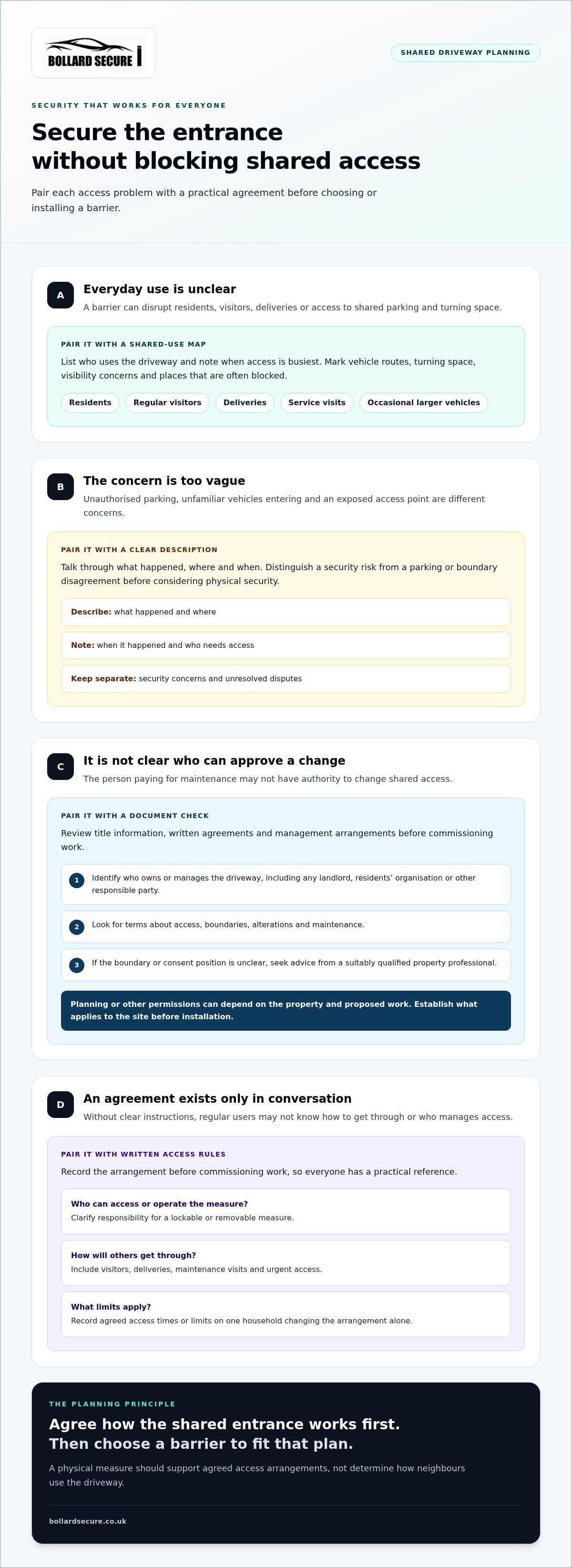
Map who uses the shared driveway and when
Build a practical picture of everyday use before discussing hardware. Note who comes and goes, when access is busiest and where vehicles need room to manoeuvre. A driveway that seems clear during the day may be used by residents returning in the evening or a delivery driver heading to a rear entrance.
List residents, regular visitors, deliveries and any shared parking arrangements.
Mark vehicle routes, turning space, visibility concerns and places that are often blocked.
Note access needs that vary by household or time, including service visits and occasional larger vehicles.
This simple map can expose practical conflicts early. A barrier that appears conveniently placed for one home, for example, could narrow another resident’s turning route or make a shared parking space difficult to reach.
Agree the problem before choosing a barrier
Talk through the issue with everyone who uses the driveway. Ask what has happened, where and when, rather than starting with a preferred product. Is the concern a vehicle left in a shared space, unfamiliar vehicles entering, or an exposed access point? A clear description helps distinguish a security risk from a parking or boundary disagreement.
Record the points you agree on: who needs access, how visitors and deliveries will get through, who will manage access arrangements and how recurring problems will be raised. Keep unresolved issues visible too. A written note gives neighbours something specific to refer to as plans develop.
Once the purpose and everyday access needs are clear, assess physical security options against them. This keeps the decision focused on a workable shared arrangement instead of choosing a barrier first and trying to fit everyone’s routine around it.
Check permissions, boundaries and access responsibilities before making changes
Before arranging work, establish who owns or manages the driveway and what the property documents say about its use. Title documents, written agreements and management arrangements can clarify access rights, maintenance responsibilities and how changes are handled. The arrangements may differ between properties sharing the route.
This matters because a barrier can affect more than the person paying for it. A change to a jointly used entrance could alter how others reach their homes or use parking and service access. Treat neighbour agreement and the relevant property arrangements as part of securing a shared driveway, not paperwork to leave until after you have chosen equipment.
Establish who can approve physical changes
Start with the documents. Check title information and any written arrangements that refer to the driveway, its boundaries, access or upkeep. Clarify whether the route is jointly owned, belongs to one property, or is managed by a landlord, residents’ organisation or another party. Paying for maintenance does not automatically mean someone has authority to change shared access.
Identify who holds relevant ownership or management responsibilities.
Look for terms about access, alterations and maintenance in the available documents.
If the boundary or consent position is unclear, seek advice from a suitably qualified property professional before commissioning work.
Planning or other permissions can depend on the property and proposed work. Avoid relying on a general rule for every driveway. Establish what applies to the site before installation, particularly if the proposed position or groundwork could affect a boundary or access route.
Set out practical access rules in writing
Once you have identified the people with relevant rights and responsibilities, record the agreement before commissioning work. Written confirmation turns a general discussion into a process everyone can follow and provides a reference if arrangements are questioned later.
Cover practical details, not just whether a barrier is acceptable. Agree who can operate or access a lockable or removable measure, how visitors and deliveries will get through, and how maintenance visits will be managed. Include a workable approach to urgent access, and make sure regular users know what to do. Keep instructions straightforward, especially if several households share responsibility.
Record any limits too. Neighbours might agree, for example, that access must remain available at particular times, or that no one household can change the arrangement alone. If there is a disagreement about parking, boundaries or responsibilities, note it separately rather than treating a security installation as a way to settle it.
With responsibilities and access rules clear, consider suitable driveway security bollards as part of the agreed plan. Bollard Secure also provides professional installation for customers who already have suitable bollards. The work includes groundwork, core drilling and secure concreting according to product specifications.
Compare shared driveway security options by access pattern
The right bollard depends on how the driveway is shared, not simply on how much of it you want to restrict. Consider how often vehicles need to pass, how many households will operate or manage the barrier, and whether there is enough room to use it without affecting turning or pedestrian movement. A measure that suits a rarely used entrance may become awkward when several households need frequent access.
Use this comparison to shortlist options against the agreed access plan. Each offers a different balance of permanence and operating steps. None replaces agreement between the people who use the driveway.
When a fold-down or telescopic bollard may suit
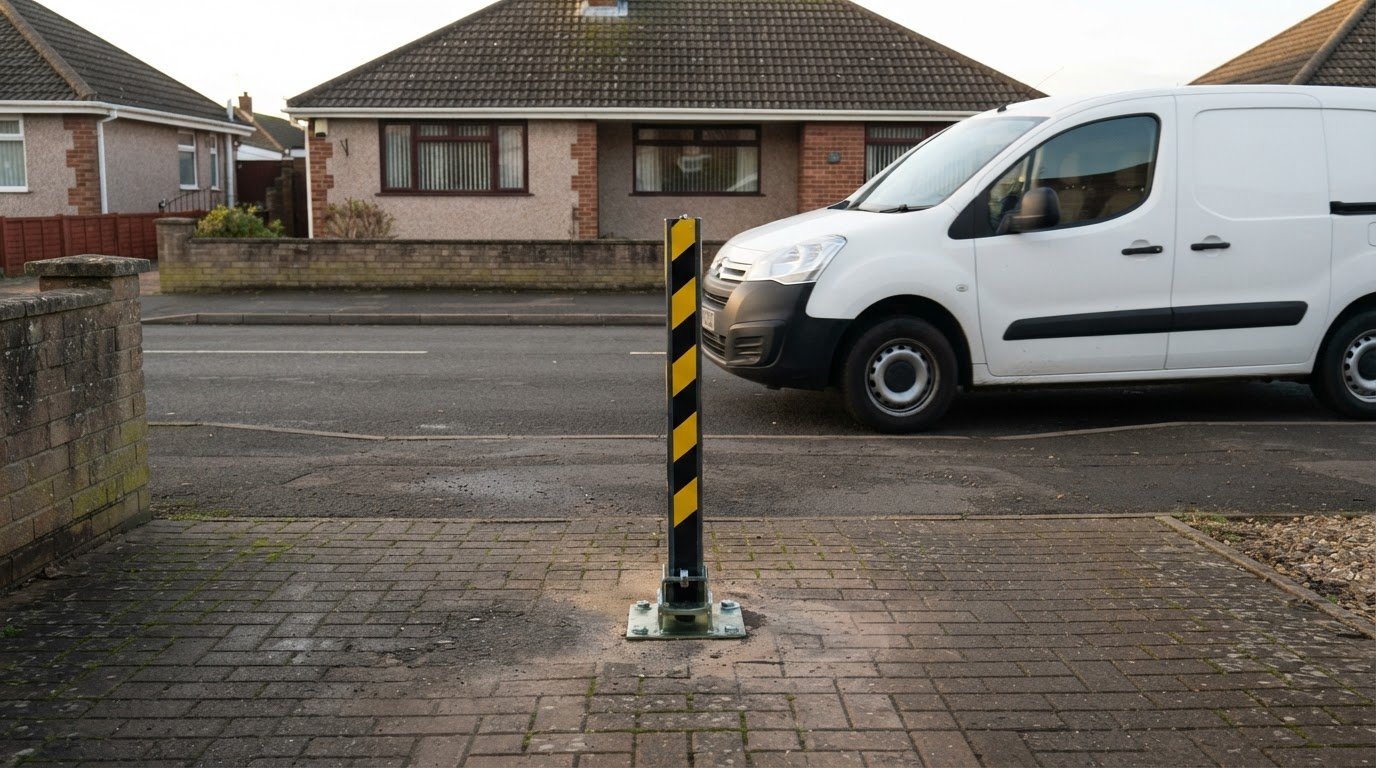
A fold-down bollard can suit a shared driveway where authorised vehicles need regular access, provided users agree how to operate it. A telescopic bollard retracts into the ground to open the route. With either option, check the position carefully: users need space to approach and pass without obstructing other vehicles or narrowing a shared route. The fold-down bollard driveway buying guide covers points to consider when assessing that option.
When removable or permanent barriers may suit
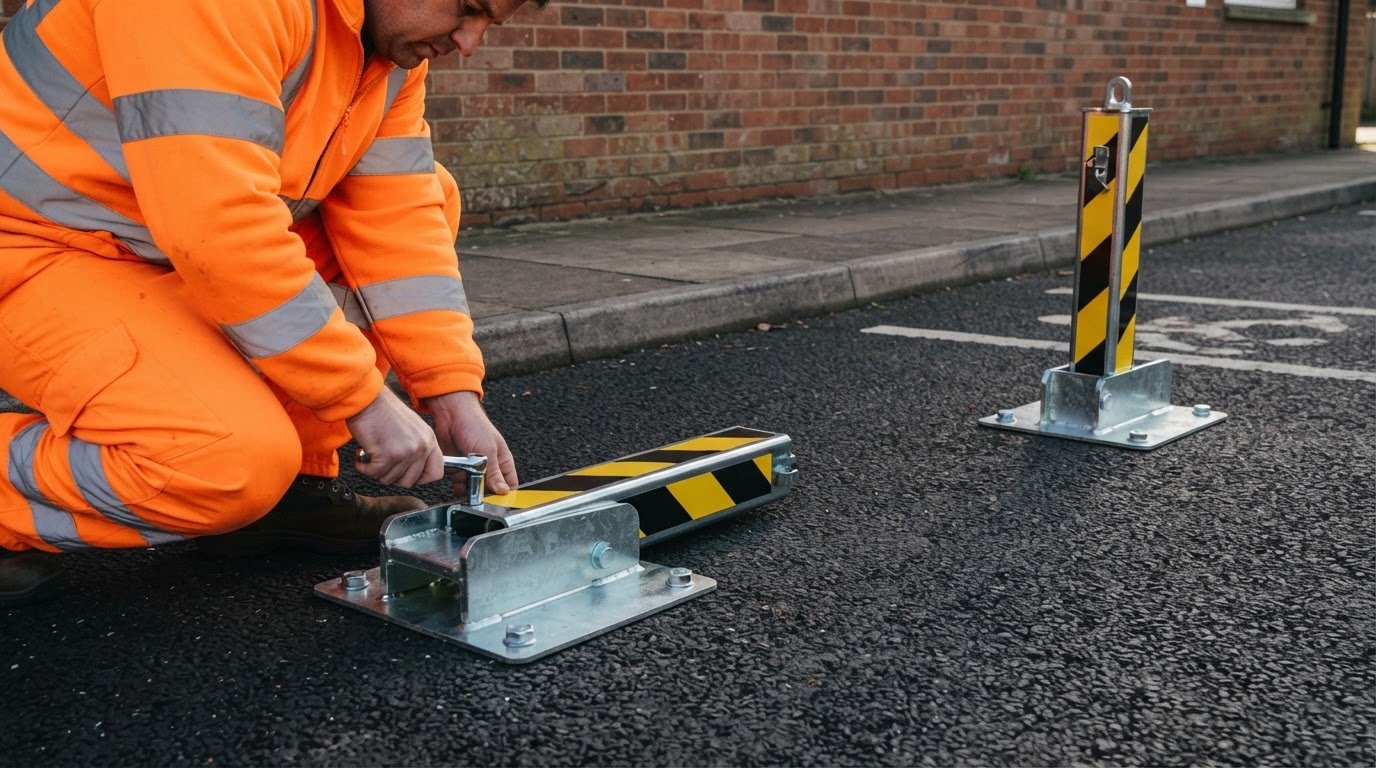
A removable bollard may suit occasional access if authorised users can manage taking it out and putting it back. That handling step needs to be practical for everyone who relies on the route. Static bollards are best understood as permanent demarcation, not a flexible shared-access solution. Parking posts may be relevant if the main concern is protecting an allocated parking space rather than controlling entry along the driveway.
Before deciding, consider the route width, operating space and how often access changes. The best option for securing a shared driveway is one that works with the agreed routine and site conditions. If a barrier is inconvenient to use, people may be tempted to leave it out of operation, so consider the steps each household will actually need to follow.
Plan the site and installation around everyone’s daily access
A suitable bollard still needs a suitable position. On a shared driveway, placing it too close to a turning area, parking space or pedestrian route can cause daily inconvenience. Plan in sequence: confirm the shared agreement, measure the site, mark a possible location, then arrange installation around agreed access needs. Keep vehicle and pedestrian routes usable during planning, and make sure everyone affected understands when access may be restricted during the work.
Before settling on a location, check the following:
Confirm the agreement. Make sure the proposed position and operation match the access arrangements everyone has accepted.
Measure the driveway. Note its width and the space vehicles need to enter, turn and reach parking.
Mark a possible position. Consider how the barrier will sit in relation to shared routes and pedestrian movement.
Plan the installation. Account for the surface, groundwork and access needed to carry out the work.
Assess the driveway before choosing an installation point
Sketch the site or mark it out, noting boundaries, vehicle routes, parking positions and shared turning areas. Look beyond the intended bollard position: a vehicle may need room to swing into a space, or a pedestrian route may pass close to the entrance. Avoid placements that unnecessarily restrict visibility or make routine access harder for another household.
Note the surface type and condition, including paving or other features that may affect groundwork.
Identify drainage and any known underground services near the proposed location.
Flag site constraints for assessment before fixing the position or starting work.
Coordinate installation and future operation
Agree the installation timing and temporary access arrangements with everyone affected. Consider how residents will reach their homes and where deliveries or service visits can go during the work. Excavation, core drilling and concreting depend on the product specification and site conditions, so plan for both rather than assuming every surface can be treated alike.
Once installed, make the operating process clear. Share instructions and ensure authorised users can access keys or controls where relevant. If a household changes or a regular user needs access, the agreed process should be easy to explain and follow.
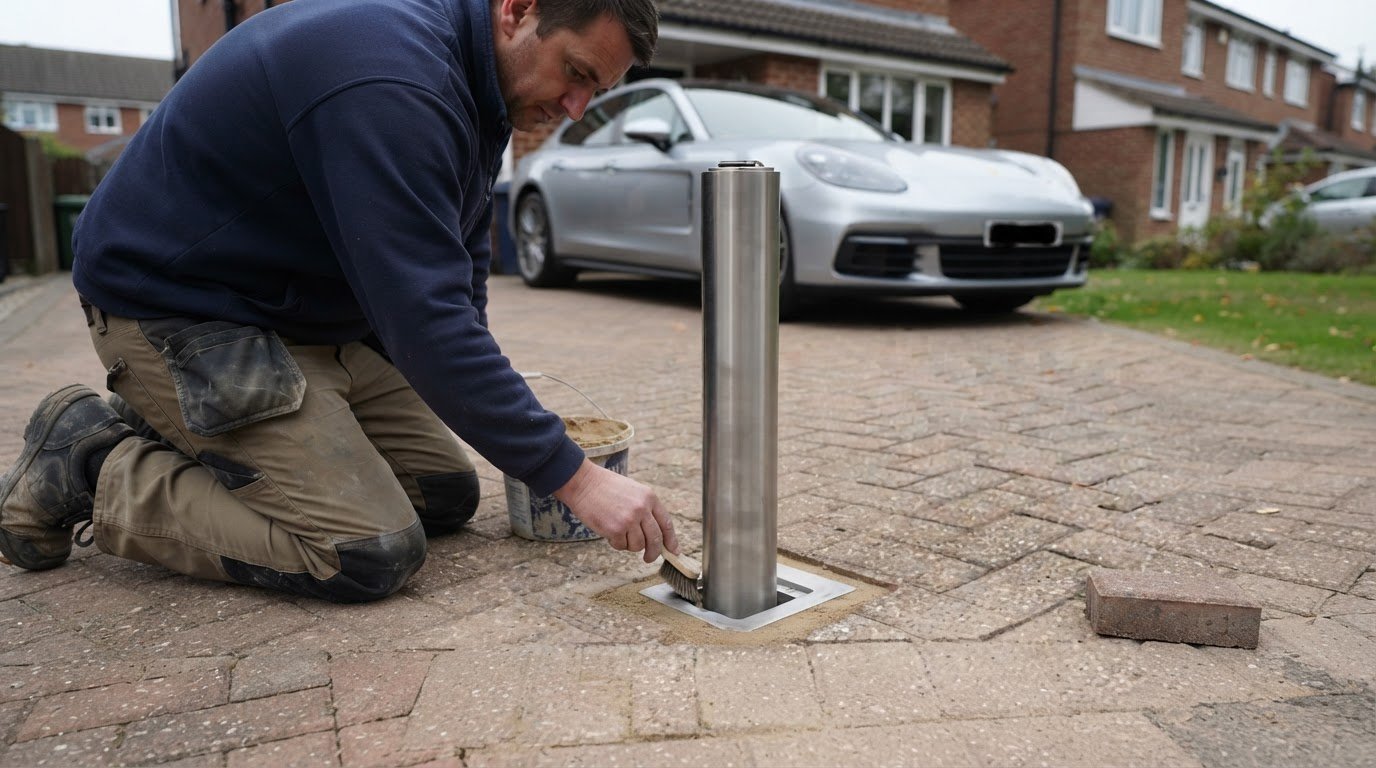
Bollard Secure’s installation-only service is for customers who already have suitable bollards. Professional installation includes groundwork, core drilling and secure concreting according to product specifications. To plan the installation of customer-owned bollards, arrange professional bollard installation.
Put the shared driveway plan into action with a suitable barrier
Once access arrangements are agreed, responsibilities understood and the site assessed, choose a barrier that works in practice. The sequence matters: agree how the route will be used, establish who can approve changes, compare suitable options and assess the installation point. This keeps the decision focused on everyone’s needs, not just a product preference.
Before proceeding, make sure your plan answers four questions:
Does the barrier address the specific security concern?
Can authorised users operate it as often as access is needed?
Will its position preserve agreed vehicle and pedestrian routes?
Do the relevant people understand and accept the arrangement?
If any answer is unclear, resolve it before arranging installation. A barrier that is awkward for one household to use can undermine the shared plan, even if it seems suitable at first.
Match the security measure to the agreed arrangement
Choose a barrier based on how often vehicles need authorised access and how it will be operated. Consider whether every regular user can follow the agreed process consistently, including visitors or delivery drivers where relevant. The physical measure should support the arrangement, not replace it. If household needs change, revisit the agreement and assess whether the position and operating process still work for everyone.
Arrange supply or installation support
Bollard Secure supplies fold-down, telescopic, removable and static bollards for driveway security. For customers who already own suitable security bollards, its installation-only service includes groundwork, core drilling and secure concreting according to product specifications. The installation plan can follow the agreed access arrangement and site conditions.
Keep the practical details in view: the agreed location, who will operate the barrier and how authorised users will pass through. This gives neighbours a clear shared plan for securing a shared driveway, with the hardware serving a defined purpose.
Explore driveway security solutions to find a suitable next step for your agreed plan.
Make shared access work for the long term
A shared driveway plan should remain useful as households, visitors and routines change. Agree how changes will be discussed, and keep access arrangements clear for new residents and regular users. This makes securing a shared driveway a practical shared decision, rather than a source of friction.
Bollard Secure supplies driveway security options across the UK and provides installation support. For customers who already own suitable bollards, its installation-only service covers the groundwork, core drilling and secure concreting required by the product specifications. Match the agreed plan to a solution that suits the site and the people who use it.
Explore driveway security solutions and take the next step towards fair, practical access. With a clear arrangement in place, you can move forward with confidence.
Frequently Asked Questions
Can one neighbour install a bollard on a shared driveway?
Not automatically. Whether one neighbour can approve a bollard depends on ownership, property documents and any existing access agreement. Before arranging work, establish who has authority to make changes and whether the proposal affects another person’s rights or use of the route. Discuss the position and day-to-day operation with everyone affected. If the documents leave room for doubt, get suitable property advice before proceeding.
Do all neighbours have to agree to secure a shared driveway?
There isn’t one answer for every property. The relevant documents and management arrangements determine how decisions about shared access should be made. Don’t assume either that one household can decide alone or that every user has the same formal role. Identify the decision-making process first, then keep a written record of the proposal, responses and agreed access arrangements.
Is a bollard suitable for every shared driveway?
No. Suitability depends on the driveway’s layout, the reason for adding a barrier and how often authorised vehicles need to pass. A bollard that requires regular operation, for example, may be inconvenient if users can’t reliably follow the agreed process. Check that its position leaves enough room for vehicles and pedestrians, and that the surface suits the proposed installation. A barrier can help manage access, but it can’t resolve every parking or boundary issue.
Can visitors and delivery drivers still access a driveway protected by a bollard?
Yes, if the shared access plan explains how legitimate visitors will get through. Decide how residents will provide instructions, who can operate the barrier and what a delivery driver should do if nobody is available to help. Consider recurring visitors, such as carers or tradespeople, as well as occasional deliveries. Clear arrangements reduce confusion and help prevent the barrier being left open simply because access is inconvenient.
Is planning permission needed to install a driveway bollard?
It depends on the property and proposed work, so don’t rely on a general answer. Check the property documents and establish whether any permissions or consent apply to the specific location and installation. This is especially relevant if the driveway is shared or the proposed work could affect access rights. Resolve uncertainties before work starts, and ensure the installation plan reflects site conditions and any applicable requirements.
What should we do if neighbours disagree about driveway security?
Pause the installation discussion and identify what each household is concerned about. One neighbour may be worried about vehicles entering, whilst another may be focused on parking or the effort of operating a barrier. Write down the issues separately and note any points already agreed. If the disagreement involves ownership, access rights or authority to make changes, review the relevant documents and seek suitable independent property advice before commissioning work.
Who can install a bollard we have already bought?
Bollard Secure offers an installation-only service for customers who have already purchased their security bollards. The work includes groundwork, core drilling and secure concreting according to the product specifications. Installation also needs to suit the driveway’s conditions and the chosen hardware. Before work is arranged, coordinate access with the people who use the route so residents can plan around installation and understand any temporary changes.
Comments