
Fold-Down Bollard for Driveway: 2026 UK Buying Guide
A fold-down bollard can be a poor fit for a driveway, even when it seems like the simplest way to control vehicle access. Before choosing a fold down bollard for driveway security, consider the surface, available space and how often you’ll need to raise and lower it. The right barrier should suit your daily routine as well as your access-control needs.
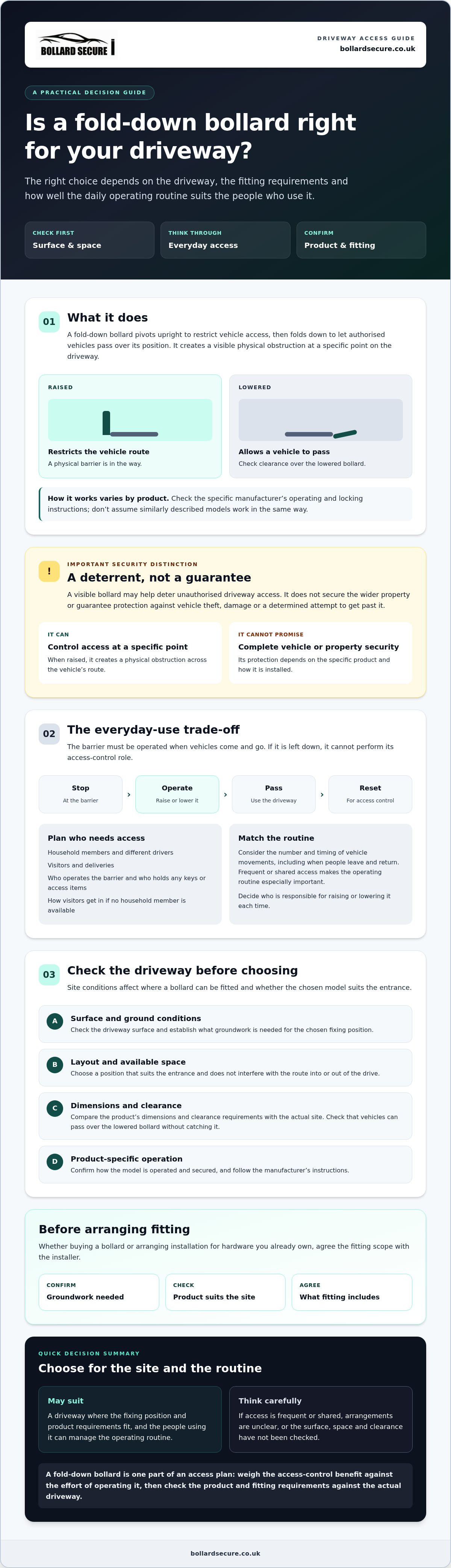
A fold-down bollard pivots upright to restrict vehicle access, then folds down when you need to drive over it. The driveway layout and ground conditions can affect where it can be fitted, while protection depends on the specific product and how it’s installed. A visible barrier may help deter unauthorised access, but it isn’t a guarantee against theft or damage.
This guide explains how fold-down bollards work in everyday use and what to check before buying, including driveway surface, positioning, operation and product suitability. It also covers what to ask about fitting, whether you’re buying a bollard or arranging installation for hardware you already own. Use these checks to decide whether a fold-down model suits your driveway or whether another option is worth considering.
Table of Contents
What a fold-down bollard for a driveway does and when it makes sense
A fold-down bollard is a driveway access barrier that stands upright to restrict vehicle entry and lowers when authorised access is needed. It gives drivers a visible physical obstruction at a specific point, which may help deter unauthorised use of a private driveway. It doesn’t secure the wider property or guarantee protection against theft, damage or a determined attempt to get past it.
That distinction matters. A fold down bollard for driveway security is one part of an access plan, not a promise that a vehicle can’t be taken. Its usefulness depends on whether it can be positioned to suit the entrance and whether the people who need access can operate it consistently. For a broader overview of bollards in traffic control and security, see Traffic bollards.
How a fold-down bollard changes between raised and lowered positions
Raised, the bollard creates a physical obstruction across the vehicle’s route. Lowered, it allows a vehicle to pass over its position. The owner raises or lowers it as access arrangements require, so it needs to be operated when vehicles are coming or going.
Operating and locking mechanisms vary by product. Before buying, check the manufacturer’s instructions and confirm how the specific model is secured and operated. Don’t assume that products with the same general description work in the same way.
Driveway situations where a fold-down bollard may suit
A fold-down bollard may suit someone who wants to control vehicle access to a private driveway and is comfortable operating the barrier as part of their routine. Consider who uses the entrance. A household with occasional visitors may have different access needs from one where several drivers come and go throughout the day.
Frequent or shared access deserves particular thought. Agree who will operate the bollard and how visitors or deliveries will get through. If the access arrangements are unclear, a barrier that seems suitable on paper may become awkward to manage day to day.
Think of the bollard as a way to restrict vehicle access at the driveway entrance. It doesn’t replace wider property security or guarantee protection against vehicle theft. Weigh the access-control benefit against the effort of raising and lowering it, then check that the product and its fitting requirements suit the site.
How fold-down driveway bollards work in everyday use
Using a fold-down bollard adds a task to each journey: stop, operate the barrier, pass through, then return it to the position needed for access control. The exact sequence depends on the product, so check the manufacturer’s instructions before buying. Consider whether everyone who uses the driveway can operate it comfortably and reliably.
That routine is the trade-off. The barrier creates a physical obstacle when raised, but it must be lowered for authorised vehicles to pass. If it’s left down, it can’t perform that access-control role. GOV.UK’s official government guidance on traffic calming covers measures in a public-road context, so it shouldn’t be treated as product-specific guidance for a private driveway.
Locks, keys and authorised access
Locking arrangements differ between products. Confirm what mechanism is supplied, how it works and what the manufacturer recommends for everyday use. Don’t judge security by the lock alone or assume one arrangement is stronger without comparable evidence about the products.
Make an access plan before choosing a model. Decide who needs to use the driveway, who will hold any keys or access items, and how visitors will get in if no household member is available. Clear arrangements can prevent the barrier becoming a daily source of delay.
Planning around regular driveway use
Consider the number and timing of vehicle movements, not just how many vehicles are kept at the property. Think about when household members leave and return, whether different drivers need access, and how visitors or deliveries will be handled. A fold down bollard for driveway access may be manageable for occasional movements, but frequent trips make the operating routine more important. Decide who is responsible for raising or lowering it each time.
Check the lowered position as well. It must leave enough clearance for vehicles to pass without catching the barrier, and its placement shouldn’t interfere with the route into or out of the drive. Compare the selected product’s dimensions and clearance requirements with the actual site, rather than relying on a general product description.
Confirm the operating and locking instructions for the specific model.
Agree how household members, visitors and delivery drivers will get access.
Check the raised and lowered positions against vehicle paths and site dimensions.
Before settling on a product, compare the available driveway bollard options and check which model’s operation and access arrangements suit your household.
Will a fold-down bollard provide enough driveway security?
A fold-down bollard can help restrict vehicle access and make entry to a driveway less straightforward, but it can’t guarantee that a vehicle won’t be stolen or damaged. Its contribution depends on the product, installation, site and circumstances. Treat it as one part of your security arrangements, not a complete solution.
A driveway bollard can deter unauthorised vehicle access, but it can’t guarantee protection against theft, damage or a determined attempt to get past it. It creates an obstacle at the driveway rather than preventing every possible method of attack. Assess a fold down bollard for driveway security by checking the specific product’s features and suitability for your site, not by assuming all bollards can withstand the same conditions.
What a driveway bollard can and cannot do
When raised and correctly positioned, a bollard presents a visible physical barrier to vehicles using the entrance. This may discourage casual or unauthorised access, but results aren’t guaranteed. Product design, installation, the surface and layout, and the nature of an attempted entry can all affect performance.
Check any claims about security ratings, testing or approval against evidence for the exact product you’re considering. Don’t assume a rating or scheme applies to every model, or that a general description explains how a bollard will perform in your driveway.
Using bollards alongside other vehicle-security measures
Think in layers. A bollard addresses access at the driveway entrance, while sensible parking habits and the vehicle’s own security features address other parts of the risk. Park in a secure position where possible and use the security features provided with the vehicle. Follow the vehicle manufacturer’s guidance on protecting keys, particularly if keyless entry is a concern.
A driveway bollard alone doesn’t prevent keyless vehicle theft or protect a car once it’s beyond the barrier. Consider how your vehicle is used, where it’s parked and what other protective measures are appropriate for your household. If a product is described as tested, approved or suitable for a particular security purpose, ask for supporting details and confirm they relate to that specific model.
Before deciding whether a fold-down bollard offers the access control you need, clarify what it’s designed to do, how it must be installed and what evidence supports any performance claims. This gives you a more realistic basis for comparing options and combining the barrier with other security measures.
How to choose a fold-down bollard for your driveway
Choose for the driveway you have, not just the product description. A fold down bollard for driveway use needs to fit the vehicle route, suit the ground and work with the household’s access routine. Before comparing products, note where vehicles turn, park and open their doors. Then check the selected bollard’s dimensions and clearance requirements against those areas.
Check the driveway layout and ground conditions
Mark the likely position and consider the full movement of vehicles, not just the point where they enter. The bollard shouldn’t obstruct the route, parking position or access to vehicle doors in either its raised or lowered position. Check the surface and, where possible, what lies beneath it, because the fixing requirements need to suit the site. If you’re unsure about the ground or positioning, ask the supplier or installer to assess suitability before proceeding.
Match the bollard to access habits and security priorities
Consider how often the barrier will be operated and who will use it. Check the specific product’s operating instructions, locking arrangement and maintenance guidance. Ask what care it may need in the conditions at your property and whether replacement parts are available. Compare documented product details rather than relying on general claims that one option is automatically best.
Use this checklist to guide a product or installation discussion:
Keep product and fitting questions together. If you already own compatible hardware, ask whether an installation-only arrangement is suitable and confirm the scope of work. Bollard Secure supplies fold-down bollards and offers installation-only work for customer-owned hardware, subject to suitability and an agreed scope.
Discuss your driveway bollard requirements and confirm which product details and fitting requirements need checking for your site.
Buying and fitting a fold-down driveway bollard: practical next steps
A clear process helps prevent choosing hardware that doesn’t suit the driveway or leaving uncertainty about the fitting work. Take these steps before relying on a fold-down bollard:
Assess the site. Note the driveway surface, access route and intended position. Share these details with the supplier or installer, including any concerns about the ground beneath the surface.
Confirm product requirements. Check the manufacturer’s documentation for dimensions, materials, locking method and fixing instructions. Make sure the operating and clearance requirements suit the site.
Agree the fitting scope. Confirm who is supplying the bollard, what work is included and what preparation is expected. Groundwork and fixing requirements depend on the product and site.
Follow the instructions. Once fitted, use and maintain the bollard in line with the manufacturer’s guidance.
These checks matter because a product may be suitable in principle but still require a particular fixing method or site conditions. If the ground or positioning is uncertain, ask for the site requirements to be checked before ordering or booking work.
What to confirm before ordering or booking fitting
For a fold down bollard for driveway use, verify the product’s dimensions, materials and locking arrangement rather than relying on a general description. Share information about the driveway surface, vehicle access and proposed position, then ask whether the product’s installation requirements match those conditions.
Be clear about the purchase and fitting arrangement. Bollard Secure supplies fold-down bollards and offers an installation-only service for customers’ own hardware. If you already have a bollard, confirm its compatibility and check the current availability and scope of installation work before proceeding. Ask exactly what the agreed work includes. The service description covers groundwork, core drilling and secure concreting according to product specifications, but don’t assume unconfirmed extras are included.
What to expect after installation
Follow the manufacturer’s operating and maintenance instructions for the exact model. Make sure everyone who uses the driveway understands how the bollard is operated, secured and lowered for access. If its operation, position or suitability is unclear, ask the supplier or installer before relying on it as an access barrier.
Clear answers at each stage make it easier to choose and use the right product. Ask Bollard Secure about fold-down bollards and installation to discuss product suitability and confirm the fitting scope for your requirements.
Make your next step a well-matched choice
A fold down bollard for driveway security is most useful when its position, fixing requirements and everyday operation suit your home. Check the product’s dimensions and instructions, consider how household members will manage access, and remember that a bollard can restrict vehicle entry but can’t guarantee protection against theft or damage.
Bollard Secure supplies fold-down bollards and offers a separate installation-only service for customers with their own hardware. If you’re considering fitting support, confirm that your bollard is suitable and check the current availability and scope of work before proceeding.
Ask Bollard Secure about a fold-down bollard for your driveway and clarify the product and fitting details for your site. With the right checks in place, you can move forward with greater confidence.
Frequently Asked Questions
What is a fold-down bollard for a driveway?
A fold-down bollard is a physical barrier that can be raised to restrict vehicle access and lowered to let authorised vehicles pass. It’s often positioned at a driveway entrance, but the right location depends on the layout and product requirements. Operating and locking mechanisms vary, so check the selected model’s instructions and specifications rather than assuming all fold-down bollards work in the same way.
Are fold-down bollards effective at stopping car theft?
Fold-down bollards can help deter unauthorised vehicle access, but they can’t guarantee that a car won’t be stolen or damaged. Their effect depends on the product, its installation, the driveway and the circumstances. Treat a bollard as one layer of security. Combine it with sensible parking habits and the vehicle’s own security features, particularly if keyless entry is a concern.
Can a fold-down bollard be installed on any driveway surface?
No. Whether a particular bollard can be fitted depends on its fixing requirements and the driveway’s surface and ground conditions. Check the manufacturer’s installation specifications, including dimensions and clearance needs, against the proposed position. If you’re unsure what lies beneath the surface or whether the site is suitable, ask the supplier or installer to assess it before ordering or arranging fitting.
Do fold-down driveway bollards lock?
Locking arrangements vary by product, so check the specifications to confirm whether the model you’re considering locks and how it operates. Read the manufacturer’s instructions and consider who needs authorised access, how keys or other access items will be managed, and what happens when visitors need to enter. Don’t assume a particular lock type is more secure without product-specific evidence to support the comparison.
Are fold-down bollards convenient for daily driveway access?
They can suit daily use if the household is comfortable operating the barrier as vehicles come and go. Convenience depends on how often access is needed, who will raise or lower it, and how visitors and deliveries will be handled. Check that the lowered bollard leaves enough clearance for vehicles to pass, and make sure everyone who uses the driveway understands the operating routine.
How is a fold-down bollard fitted to a driveway?
Fitting depends on the selected bollard and the driveway site. Product instructions set out the fixing requirements; groundwork may involve excavation, core drilling or secure concreting, as appropriate to the specifications. Bollard Secure supplies fold-down bollards and offers an installation-only service for customer-owned hardware. Before proceeding, confirm that your bollard is compatible and check the current availability and scope of fitting work.


Comments