
Car Park Height Barriers: How to Choose the Right System in 2026
The safest setting for car park height barriers isn’t automatically the lowest one. Set the clearance too high and oversized vehicles may still get in; set it too low and legitimate vans or other vehicles could be turned away. Start with the tallest vehicles your site needs to admit and the tightest clearance along their route, rather than guessing from the entrance alone.
If you’re unsure what height to specify or whether a barrier will interfere with day-to-day access, the answer depends on more than the entrance height. Vehicle types, roof-mounted equipment or loads, the approach layout and how access is managed all matter. A site-specific assessment helps balance protection with practical use.
This guide explains how height restriction barriers control vehicle access, what to measure before choosing a system and how to plan visible warnings. It also compares height barriers with manual arm barriers, which may suit sites where the priority is managing general access rather than restricting vehicle height. Use the checks below to prepare for a conversation with a supplier or competent professional.
Table of Contents
What do car park height barriers prevent, and when are they useful?
A car park height barrier is a physical access-control measure that warns or restricts vehicles above a specified height, depending on its design. Car park height barriers are commonly considered at entrances to covered or enclosed parking where overhead clearance is limited. Their purpose is to help prevent vehicles that exceed the permitted height from entering an area where they may not fit.
Height restrictions can also help operators manage which vehicles use a site. The reasons for height restrictions include protecting routes and structures where clearance is limited. For a car park, the practical aim is to match entry arrangements to the space beyond the barrier and make the restriction clear to approaching drivers.
Which car parks may need a height restriction barrier?
Consider a height restriction where a low roof, beam or other overhead feature could limit vehicle access. This may apply to covered parking, private developments or commercial sites, but the right approach depends on the site rather than its label. A car park used mainly by cars has different access needs from one that regularly admits vans, service vehicles or other taller vehicles.
Check both the vehicle mix and the way people enter. A controlled entrance used by familiar permit holders may present different practical considerations from a busy entrance serving visitors and deliveries. Note when taller vehicles need access, how often they arrive and whether there is a suitable alternative route. These details help establish whether height control is useful and how drivers will encounter it.
What a height barrier can and cannot do
Depending on its design, a barrier may provide a visible warning, a physical restriction or both. It can alert drivers before they enter a low-clearance area and form part of a site’s access-management arrangements. Be clear about the intended function before selecting a system.
A height barrier isn’t a substitute for assessing the whole entrance and the risks specific to the site. Nor should it be treated as protection against every form of unauthorised access: controlling vehicle height is different from controlling who may enter. Don’t assume a barrier is collision-proof or that it will prevent all vehicle damage. Consider sightlines, approach conditions and how authorised vehicles will be accommodated, then review the proposal with a supplier or competent site professional.
How car park height barriers manage vehicle clearance
A height restriction works only when its setting reflects both the vehicles the site needs to admit and the clearance along their route. Choosing a figure from the entrance alone can miss a low beam or another obstruction further inside. Check the full vehicle route, then set the barrier specification to suit its tightest clearance and the vehicles that need access.
How to think about vehicle height and available clearance
Start by identifying the tallest vehicles that must legitimately enter. Consider their normal operating configuration, including roof racks, equipment or loads where relevant. Then assess the complete route, from the approach through the entrance and into the parking area.
Find the lowest overhead obstruction on that route, not just the height at the barrier. Changes in level, the position of beams or the route a vehicle must take may affect the clearance available. Ask a competent site professional to confirm the measurements, suitable clearance and any allowance needed for site conditions. Don’t assume a barrier setting can be chosen safely from a single measurement.
The restriction also needs to work in daily use. A setting that excludes vehicles the site relies on can cause avoidable access problems. Conversely, a setting that doesn’t account for the route’s constraints may not provide the intended control. If a vehicle’s height varies with its load or equipment, include that in the assessment rather than using its unladen height.
How warnings and barrier visibility support safer access
Drivers need a fair opportunity to notice a restriction and decide whether to proceed. Plan where warnings will be seen on the approach, whether the barrier is visible from a driver’s viewpoint and whether anything could obscure either. Check the entrance in the conditions in which it will operate, including after dark if the site is used then.
Lighting, sightlines, signs and other obstructions all affect how clearly drivers can assess the entrance. Consider whether a driver approaching behind another vehicle would still see the warning in time to respond. These are practical planning checks, not a substitute for confirming which formal signage or safety recommendations apply to the specific site. Verify those with a competent professional rather than assuming one arrangement suits every car park.
Barrier construction and operation can vary. Before choosing, ask the supplier to confirm the proposed configuration, its stated restriction and how it will function at your entrance. Bollard Secure supplies height restriction barriers for car parks and private access roads. Review its height barrier options alongside your site measurements and access needs.
Height restriction barrier or manual arm barrier: which suits the car park?
Start with the access problem. Do you need to restrict vehicles above a set height, manage which vehicles may enter, or address both needs? A height restriction barrier and a manual arm barrier serve different purposes, so they aren’t interchangeable simply because both are used at entrances.
When a height restriction barrier is the main requirement
If the priority is preventing over-height vehicles from entering a restricted-clearance area, a height barrier is the relevant option to assess. Check that approaching drivers can identify the restriction in time, and base the proposed setting on measured site conditions and the vehicles that need legitimate access. Ask the supplier to confirm that the barrier’s stated function and specification suit the entrance.
When a manual arm barrier may also be relevant
A manual arm barrier may be appropriate where the site needs to manage general vehicle passage, for example at an entrance used by authorised staff, visitors or deliveries. Consider who will operate it, how access decisions are made and whether the process fits expected traffic flow. These are separate questions from whether the vehicle fits beneath or beyond an overhead restriction.
Some sites may need to consider both functions, either at the same entrance or at different points in the access route. That’s a site-dependent possibility, not a standard arrangement: positioning, operation and compatibility need to be checked against the layout and proposed specifications. Don’t assume combining systems will improve access or safety without a site-specific assessment.
Bollard Secure supplies both height restriction barriers and manual arm barriers. Share the access problem you’re trying to solve, along with your site measurements and vehicle needs, to discuss which option may be suitable. The right choice depends on the task: car park height barriers address vehicle-height control, while a manual arm barrier manages passage.
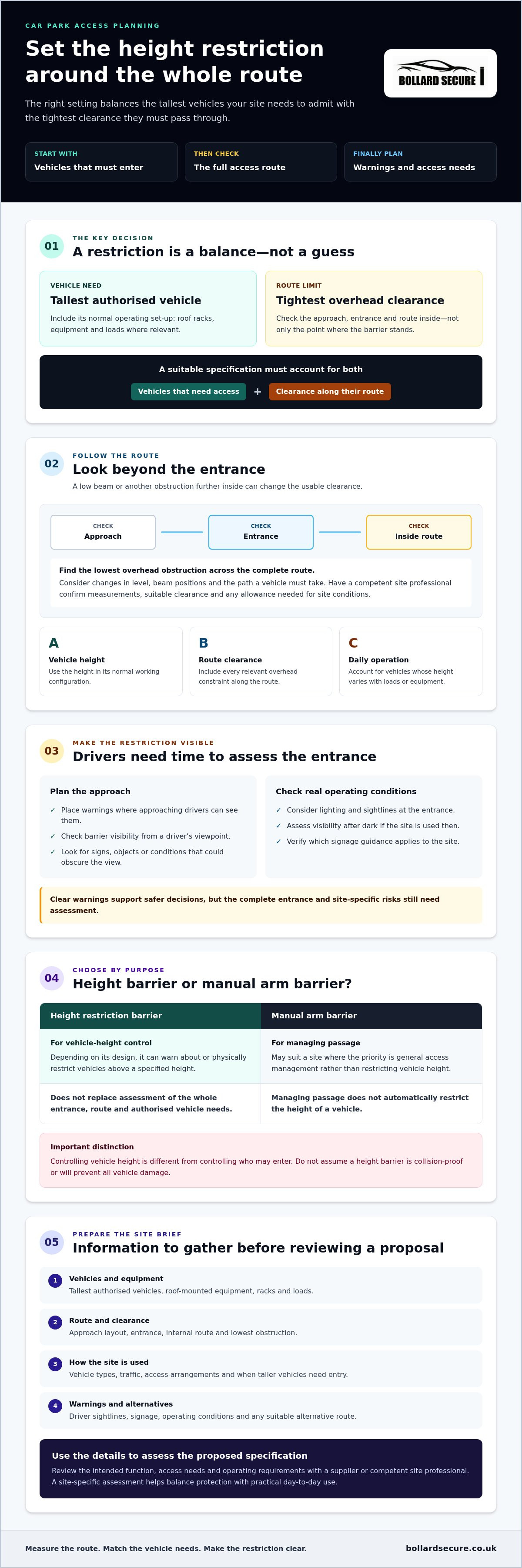
How to specify car park height barriers: a practical site checklist
A useful enquiry begins with a clear picture of how the entrance works, not just a requested barrier height. Gather the details below before comparing proposals. They’ll help a supplier assess whether the suggested system fits the site and its legitimate access needs.
Define the site’s use. Note who uses the car park, the types of vehicles expected and whether deliveries, maintenance visits or occasional larger vehicles need access.
Identify the tallest authorised vehicle. Record the vehicle types and how their height will be confirmed, including any roof-mounted equipment or loads relevant to normal use.
Measure the entrance and route. Record entrance dimensions and the lowest overhead obstruction along the full route, not only at the entry point. Include changes in level or other features that could affect vehicle clearance.
Describe the approach. Note the direction vehicles arrive from, visibility of the entrance, available stopping or turning space, and anything that could obscure a warning or barrier.
Explain traffic and operation. Describe expected traffic in practical terms, identify busy periods and explain how access is currently managed. Record who would be responsible for operating the system and responding to access issues.
Flag site constraints. Include pedestrian movement, nearby structures, existing equipment and any operational restrictions that could affect the barrier’s position or use.
Review the proposed specification. Ask how it relates to the measurements and authorised vehicles you’ve identified. Confirm the proposed configuration, operating method and maintenance expectations directly with the supplier.
Keep measurements and access requirements together, ideally with a simple site plan or photographs showing the approach and route. This gives the supplier useful context, but it doesn’t replace a site assessment where one is needed.
Before approving a proposal, clarify how it accommodates the tallest authorised vehicle without overlooking the lowest obstruction. Ask which product specifications apply and who is responsible for routine operation and maintenance. Check signage, safety recommendations, relevant standards and any legal duties with a competent professional; don’t assume one set of requirements applies to every site.
These checks help turn a general request for car park height barriers into a site-specific specification. Discuss your height barrier requirements with Bollard Secure, sharing your measurements, vehicle needs and entrance details.
Choosing a car park height barrier supplier and planning next steps
A useful supplier conversation starts with site facts, not a preferred product. Clear information helps the supplier understand the access problem and identify which details need checking before a proposal can be confirmed.
What to include in a height barrier enquiry
Prepare a concise record of the entrance and how it’s used. Include:
Measured clearances: entrance dimensions and the lowest overhead obstruction along the vehicle route.
Site layout: the approach, turning or stopping space, sightlines and any features that could affect positioning or visibility.
Vehicle requirements: the tallest authorised vehicles, how their height is known, and any equipment or loads that affect it.
Access objectives: whether the priority is restricting vehicle height, managing general entry, or considering both.
Operating conditions: expected traffic, busy periods, who will operate the system and any known entrance restrictions.
Share a simple plan or photographs if available, and ask the supplier to identify assumptions in the information you’ve provided. Clarify which measurements or operating details still need a site assessment. This helps distinguish a preliminary recommendation from a specification confirmed for the actual entrance.
Move from shortlist to a site-appropriate solution
Compare proposals against the original objective, not just the product description. Does the suggested system address height control or general access management? Ask how its proposed configuration relates to your measurements and legitimate vehicle access. Check that operating arrangements, maintenance expectations and responsibilities are set out clearly, and seek professional guidance on applicable safety, signage, standards or legal questions.
A useful proposal should make clear what has been considered, what remains uncertain and what needs confirming before a decision. If you’re comparing car park height barriers, look for an explanation of suitability and specifications rather than relying on a generic recommendation. Bollard Secure supplies height restriction barriers and manual arm barriers, with suitability dependent on your site’s requirements.
Have your measurements and access needs ready, then explore Bollard Secure’s height barrier options as a starting point for discussing a suitable approach.
Choose a barrier approach that fits your site
The right car park height barriers start with measured clearance and the vehicles your site needs to admit. Check the full route for overhead restrictions, then consider how drivers will see and respond to warnings. If your main requirement is managing general vehicle entry, a manual arm barrier may be more suitable, but it doesn’t automatically restrict vehicle height.
Before choosing, prepare your site measurements, vehicle requirements and operating needs. Ask the supplier to explain how the proposed specification addresses them, and confirm any site-specific safety or signage questions with a competent professional.
Bollard Secure supplies height restriction barriers for car parks and private access roads, as well as manual arm barriers for general site access management. Explore Bollard Secure’s height barrier options and discuss which approach may suit your requirements. Have your measurements and access needs ready, then contact Bollard Secure to take the next step.
Frequently Asked Questions
What is a car park height barrier?
A car park height barrier is a physical access-control measure designed to warn or restrict vehicles above a specified height from entering, depending on its configuration. It’s commonly considered for entrances to covered or enclosed parking areas where overhead clearance is limited. Select a barrier for the site’s measured conditions and authorised vehicles. It doesn’t, by itself, manage every form of access or replace a site-specific assessment.
How do I choose the right height for a car park barrier?
Base the proposed restriction on the tallest vehicles that need legitimate access and the lowest overhead obstruction along their full route. Measure the entrance and route, and account for relevant equipment or loads carried by authorised vehicles. Don’t rely on the entrance height alone. Ask a competent site professional to confirm suitable clearance and any necessary allowance, then check that the supplier’s proposed barrier specification fits those findings.
Can a height restriction barrier stop every large vehicle entering a car park?
No barrier should be assumed to stop every large vehicle or prevent every incident. Its effectiveness depends on its design, installation and suitability for the entrance, and some systems may primarily provide a visible warning. A height barrier addresses vehicle height, not every access or security risk. Confirm what the proposed system is designed to do, and assess signage, visibility and site-specific risks with an appropriate professional.
What is the difference between a height barrier and a manual arm barrier?
A height restriction barrier is intended to warn or physically restrict vehicles above a specified height, subject to its design. A manual arm barrier manages passage through an entrance, often as part of general site access control. An arm barrier isn’t automatically a height restrictor, so don’t treat the two as interchangeable. Choose according to whether the main need is vehicle-height control, general entry management or a site-assessed combination.
Do car park height barriers need warning signs?
Warning signs and visible cues can help drivers recognise a height restriction before reaching the entrance, but the applicable requirements depend on the site and system. Consider advance visibility, sightlines, lighting and anything that could obscure a sign or barrier. Don’t assume a general recommendation is a legal requirement for every location. Ask a competent professional to verify the signage and safety guidance that applies to your car park.
Should I choose a height restriction barrier or an arm barrier?
Choose a height restriction barrier if controlling over-height vehicle entry is the main objective. A manual arm barrier may suit a site that needs to manage general vehicle passage, but it won’t automatically restrict vehicle height. Compare your measured clearance, authorised vehicle types, traffic flow and operating arrangements. Bollard Secure supplies both height restriction and manual arm barriers, so describe the access problem and confirm suitability and specifications with the supplier.


Comments